
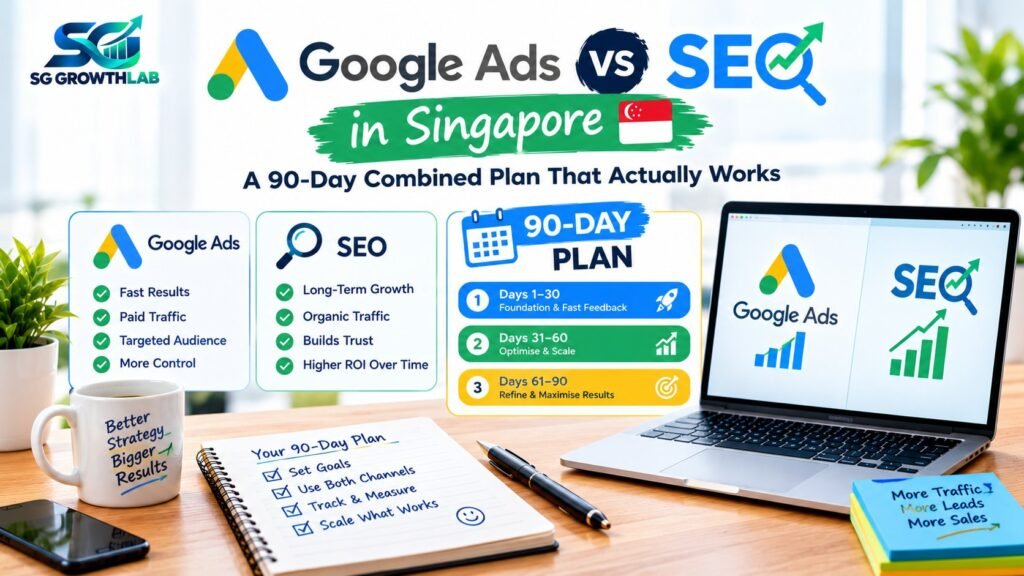
Most “Google Ads vs SEO” articles end with a vague conclusion: it depends on your goals. That is true, but it does not tell you what to do on Monday morning. In practice, many small businesses get the best results by using both in a deliberate order, with each one helping the other.
This guide gives you a practical 90-day combined plan. You will see how the two channels differ, what to do in each phase, how ad data can guide your SEO, how to track both and how to decide what to do after 90 days.
On this page:
- The Short Answer
- How They Differ in Plain Words
- When One Channel Is Enough
- Before Day 1: The Foundation You Need for Either Channel
- The 90-Day Combined Plan
- How Ads Data Helps Your SEO
- How SEO Helps Your Ads
- What to Track in a Combined Plan
- Budget Thinking for a Combined Plan
- What Happens After 90 Days?
- Common Mistakes When Combining Channels
- How SG Growth Lab Helps
- Frequently Asked Questions
- Final Thoughts
The Short Answer
Google Ads gives you speed and control. You can appear at the top of search results within days, and you pay for each click. SEO gives you durability. It takes months, but once you rank, visitors can keep coming without a cost per click. A sensible plan for many Singapore businesses is to use ads to get enquiries and data early while SEO foundations are built, then shift effort towards the mix that gives the best cost per customer.
How They Differ in Plain Words
- Speed: ads can start in days, while SEO usually takes months. See our guide on how long SEO takes in Singapore.
- Cost behaviour: ads cost money for each click and stop when you stop paying. SEO costs time and money upfront and can keep working afterwards.
- Control: ads give precise control over budget, keywords and messages. SEO depends partly on Google’s judgement.
- Intent: both can reach people who are searching and ready to act.
- Trust: many people trust organic results and reviews, while a clear ad can still win the click.
- Data: ads give fast feedback on which searches and messages bring enquiries.
When One Channel Is Enough
You do not always need both:
- Ads only: short-term campaigns, seasonal offers, new product launches or a business that sells for a limited time.
- SEO only: a business with time, a long runway and no urgent need for enquiries, or a very small budget where a free Google Business Profile and good content can carry the early months.
For many others, the combined plan below is a better fit.
Before Day 1: The Foundation You Need for Either Channel
Whichever channel you use, visitors land on your website. Before day one:
- Check your website is fast and clear on mobile.
- Set up tracking: Google Analytics, Google Search Console and conversion tracking for calls, forms and WhatsApp clicks.
- Claim and complete your Google Business Profile. See our guide on Google Business Profile SEO.
- Know your numbers: profit per customer, close rate and a test budget you can afford. See our budget planner.
- Choose your top two or three services to focus on first.
The 90-Day Combined Plan
Days 1 to 30: Foundation and fast feedback
Google Ads tasks:
- Launch one focused Search campaign around your most profitable service, using specific high-intent keywords.
- Send traffic to a matching landing page with an easy call or WhatsApp button. See our landing page service.
- Review the search terms report every few days and add negative keywords.
- Make sure every enquiry is answered quickly.
SEO tasks:
- Run a technical and on-page audit and fix the biggest problems, such as speed, indexing and titles.
- Optimise your Google Business Profile and start collecting genuine reviews.
- Make sure each main service has its own page with a clear title and helpful content.
- Set up your keyword list from real customer language.
What to expect: your ads will bring first clicks and possibly first enquiries. SEO will show little change yet, which is normal. See our guide on how long Google Ads take to work.
Decision point at day 30: are tracking and landing pages working? Do the enquiries look like real customers? If not, fix those before you scale anything.
Days 31 to 60: Learn from ads, build with SEO
Google Ads tasks:
- Use the search terms and conversion data to remove waste and move budget to the searches that bring enquiries.
- Test a second ad version and a landing page improvement, one change at a time.
- Consider adding a second service campaign if the first is stable.
SEO tasks:
- Use the ad data to guide content. If certain searches bring good enquiries in ads, create or improve organic pages for the same topics.
- Publish helpful pages or articles that answer the questions customers ask.
- Improve internal links between your service pages.
- Keep collecting and answering reviews.
What to expect: ads results start to stabilise. SEO shows early signals such as more indexed pages and rising impressions in Google Search Console.
Decision point at day 60: which searches are most profitable in ads? Are SEO pages starting to appear? Compare your cost per enquiry from ads with your break-even numbers. See our guide on break-even maths for Google Ads.
Days 61 to 90: Decide and rebalance
Google Ads tasks:
- Keep or increase spending on the searches with a profitable cost per customer.
- Reduce spend on searches where organic rankings are already strong and cost per enquiry in ads is high, but only if you can measure that organic visits bring enquiries.
- Consider remarketing to bring back visitors who did not enquire. See Google remarketing.
SEO tasks:
- Strengthen pages that are close to page one.
- Continue content and review building.
- Look at links and local mentions that build trust.
- Check what SEO is bringing in terms of enquiries, not only rankings. See our guide on how to read your SEO report.
What to expect: a clearer picture of what works. SEO may still be early, but you will see the direction.
Decision point at day 90: review the whole picture in the next section.
How Ads Data Helps Your SEO
Google Ads is a fast test lab. It can show you:
- Which search phrases bring enquiries, not just clicks. These are the best topics for service pages and content.
- Which messages work. The ad headlines that earn clicks can guide your page titles.
- Which landing page elements convert. Lessons from ads often improve your organic pages too.
- Which areas and times matter, helping you plan local SEO.
How SEO Helps Your Ads
- Better landing pages improve your ad results and reduce wasted clicks.
- A strong Google Business Profile and reviews increase trust when people see your ads and your listing together.
- Over time, organic visibility can reduce your dependence on paid clicks for the same searches.
- Brand searches grow, which is a sign that people remember you.
What to Track in a Combined Plan
Keep it simple. Every month, look at:
- Ads: spend, clicks, enquiries, cost per enquiry and cost per customer.
- SEO: impressions, clicks, key page positions and enquiries from organic search.
- Google Business Profile: calls, direction requests and reviews.
- Overall: total enquiries, total customers and total cost per customer across both channels.
Always count enquiries and customers, and ask new customers how they found you, because last-click reporting can hide the effect of one channel helping another.
Budget Thinking for a Combined Plan
There is no fixed split, but these principles help:
- Give ads enough budget to learn from. A budget that buys only a few clicks teaches you little. See Google Ads cost in Singapore.
- Give SEO enough time and consistent effort, because stopping and starting wastes progress.
- Do not spread both thin. If your budget is very small, pick one channel for the first 90 days and do the free SEO basics yourself. See our guide on DIY SEO for Singapore business owners.
- Include GST, fees and landing page costs in your plan.
What Happens After 90 Days?
Review honestly:
- If ads are profitable and SEO is growing: keep both, shift budget gradually towards the best searches and keep building content.
- If ads are profitable but SEO is slow: keep ads, continue SEO for the long term and check for technical or content gaps.
- If ads are not profitable: fix the cause first, such as tracking, the landing page or targeting, before you spend more. Our guide on Google Ads mistakes in Singapore gives you a checklist.
- If neither is working: check the basics. Your website, your offer and your response speed may be the real issue.
Common Mistakes When Combining Channels
- Expecting SEO to match ads for speed.
- Turning off ads the moment SEO shows early rankings, before organic enquiries are proven.
- Using different messages on each channel with no shared offer.
- Not tracking enquiries, so you cannot see what is working.
- Ignoring the website, which both channels depend on.
- Changing strategy every month.
How SG Growth Lab Helps
We offer both Google Ads and SEO, and we will tell you honestly whether you need one, the other or both. We start with a free audit, show you a plan for the first 90 days with price and timeline and report honestly on enquiries, not only clicks and rankings. Your accounts stay in your name, your ad budget goes directly to Google and there are no long-term contracts and no fake promises.
Learn more about our Google Ads and SEO services, or message us on WhatsApp for a free audit.
Frequently Asked Questions
Is Google Ads or SEO better for my business in Singapore?
Neither is better in every case. Ads are faster and more controllable, while SEO is slower but builds lasting visibility. Many businesses use both, starting with whichever matches their urgency and budget.
Should I start with Google Ads or SEO first?
If you need enquiries soon, start with Google Ads and begin SEO foundations at the same time. If you can wait and want lower long-term cost, start SEO early. Either way, make sure your website and tracking are ready.
Can I run Google Ads and SEO on a small budget?
Yes, but be realistic. Focus on one paid campaign with narrow, high-intent keywords, and do the free SEO basics yourself, such as your Google Business Profile, page titles and reviews.
Will SEO replace my ads eventually?
Sometimes it reduces how much you need ads for certain searches, but competitive searches and new offers often still need ads. Decide based on measured enquiries and cost per customer.
How do I know which channel brought a customer?
Track conversions in both channels, check Google Analytics and Search Console, and ask new customers how they found you. Some customers see an ad, search again later and click an organic result.
Do I need to do SEO if I already run Google Ads?
Often yes, because SEO builds a lasting asset and supports trust, landing page quality and local visibility. Ads stop when the budget stops, but good SEO can keep working.
Final Thoughts
Google Ads vs SEO Singapore businesses debate does not need a single winner. A practical 90-day plan uses ads for speed and data, SEO for long-term growth and regular decision points to keep both honest. Get the foundations right, track real enquiries, let the ad data guide your content and review at day 30, 60 and 90.
Want a 90-day plan for your own business? Get a free audit from SG Growth Lab and we will build it with you.