
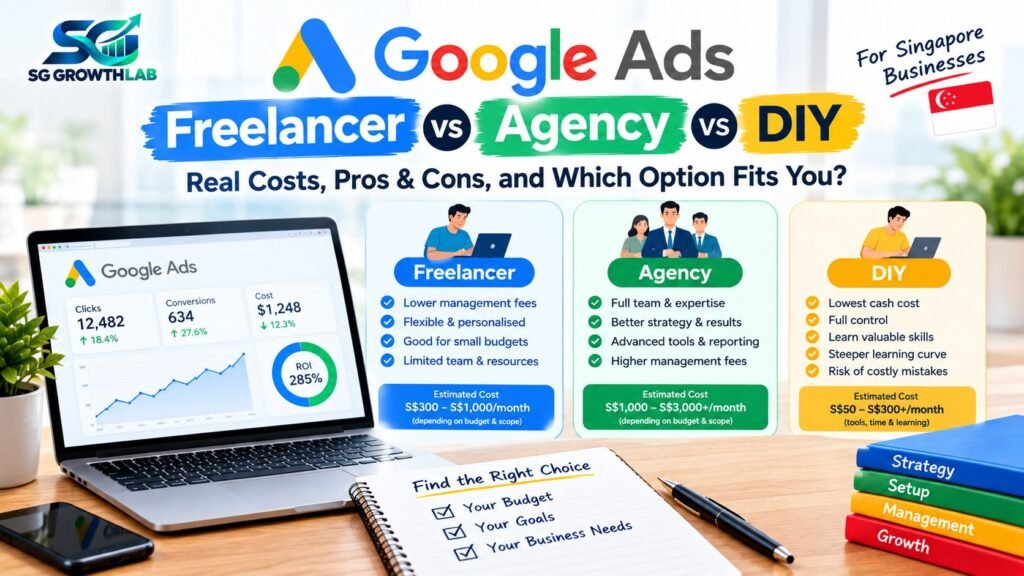
When you decide to run Google Ads, the first big question is not about keywords or bids. It is about who does the work. You can do it yourself, hire a freelancer or work with an agency. Each choice has a price tag, and the price you see is rarely the full cost.
This Google Ads freelancer vs agency vs DIY guide compares the three routes in plain terms. You will see how management fees work, how the real cost changes at different ad budgets, what DIY actually costs in time and mistakes and how to decide which route fits your business. The cost figures in this guide are hypothetical illustrations to show the maths. They are not quotes or benchmarks.
On this page:
- The Short Answer
- How Management Is Priced
- What Is the Total Cost? Think in Layers
- Illustration: How the Fee Share Changes With Budget
- Option 1: DIY
- Option 2: A Freelancer
- Option 3: An Agency
- Side by Side
- Which One Fits Your Budget?
- The Hybrid Option
- How to Compare Quotes Fairly
- Red Flags at Any Price
- How SG Growth Lab Works
- Frequently Asked Questions
- Final Thoughts
The Short Answer
DIY costs the least cash but the most time, and early mistakes can waste ad budget. A freelancer is often a good middle option for smaller accounts, as long as you check their experience and keep ownership of your account. An agency suits businesses that want a team, a defined process and ongoing support, usually at a higher management cost. At any budget, what matters most is whether the work is done well and honestly, not the label. In short, the Google Ads freelancer vs agency vs DIY question comes down to how you value your time against your budget.
How Management Is Priced
Management fees are paid on top of your ad budget, and your ad budget should go directly to Google. The most common models are:
- Percentage of ad spend: the fee is a share of what you spend on ads. It rises as your budget rises.
- Flat monthly fee: a fixed price, often tiered by budget size. It is easier to plan around.
- Setup fee: a one-off charge to build the account, campaigns and tracking.
- Hybrid: a setup fee plus a monthly fee.
- Hourly or project-based: common for audits, training and one-off improvements.
Ask every provider which model they use, what is included and what costs extra.
What Is the Total Cost? Think in Layers
The real cost of running Google Ads has several layers:
- Ad spend: what you pay Google for clicks.
- GST: Singapore’s GST rate is 9%, and Google Ads accounts with a Singapore business address are generally billed GST on advertising. Check your billing, and ask your accountant if you can claim it.
- Management: the fee, or your own time.
- Landing page and tracking: one-time or ongoing work that makes the clicks convert.
- Creative and copy: ad text, and images or video for some campaign types.
- Your response time: fast replies win more customers.
A fair comparison adds all the layers.
Illustration: How the Fee Share Changes With Budget
These numbers are hypothetical and for illustration only. They are not real quotes.
Imagine three businesses with different monthly ad budgets, each paying a hypothetical flat management fee of S$500.
- Small budget (S$1,000 a month): the fee is a third of the total spend of S$1,500. That is a large share of your marketing money, so the account must be set up carefully to justify it.
- Medium budget (S$3,000 a month): the fee is about 14% of the total of S$3,500. This is a more typical balance.
- Larger budget (S$8,000 a month): the fee is about 6% of the total of S$8,500, so the management fee has less impact on the overall result.
Now imagine a percentage model of 15% of ad spend:
- At S$1,000 of ad spend, the fee is S$150.
- At S$3,000, the fee is S$450.
- At S$8,000, the fee is S$1,200.
The lesson is not that one model is better. It is that the same fee can be heavy or light depending on your budget. At a small budget, a flat fee can swallow a big share of your money, while a percentage fee may be lighter but also come with less time on your account. At a larger budget, a percentage fee grows quickly, and a flat fee can be better value. Always ask how much time and attention the fee buys.
Option 1: DIY
Best for: very small budgets, owners who enjoy learning and have time, simple local campaigns.
Cash cost: your ad spend plus GST. No management fee.
Hidden costs:
- Your time. Setting up tracking, building keyword lists, writing ads, reading search terms and learning the platform can take many hours at the start and a few hours each week afterwards. Put a value on your time, because every hour spent on ads is an hour not spent on your business.
- Learning mistakes. New advertisers often waste part of their first budget on broad keywords, missing negative keywords, wrong location settings or poor tracking. Our guide on Google Ads mistakes in Singapore lists them.
- Missed opportunities. Without experience, you may not know what to test or how to read the data.
Strengths: full control, no fee and you learn how your business really gets customers.
Watch out for: automated recommendations that Google suggests inside the account. Some help, but some mostly raise your spend. Learn what each one does before you accept it.
How to do DIY well: start with one focused Search campaign, set up conversion tracking first, review search terms often, keep a log of changes and follow a simple weekly routine. A one-off professional audit can pay for itself.
Option 2: A Freelancer
Best for: small to medium budgets, businesses that want direct contact with an experienced person.
Cash cost: ad spend plus GST plus the freelancer’s fee, which may be flat, percentage-based or hourly.
Strengths:
- Direct communication and personal attention.
- Often more flexible and focused.
- Can be good value when the account is small to medium.
Watch out for:
- Capacity and continuity. One person can only handle so many accounts. If they become unavailable, your campaigns may stall.
- Narrow skills. Some freelancers are strong at ads but weak at landing pages or tracking.
- Account ownership. Make sure the account is in your name.
- Unclear reporting. Ask for a sample report.
How to choose well: ask for examples, speak to a past client, agree what is included in writing and make sure you hold admin access to your account. Our guide on how to choose a Google Ads agency lists 14 questions that also work for freelancers.
Option 3: An Agency
Best for: medium to larger budgets, businesses that want a team, a process and ongoing support, or those who need ads, landing pages, SEO and reporting working together.
Cash cost: ad spend plus GST plus the agency’s fee, which is often higher than a freelancer’s but includes more people and processes.
Strengths:
- A team covers strategy, setup, tracking, creative and reporting.
- Defined processes and backup if someone is unavailable.
- Often better at joining ads with your website and other channels.
Watch out for:
- Work passed to juniors or subcontractors you never meet.
- Heavy sales processes and vague deliverables.
- Long contracts with unclear exit terms.
- Reports full of impressions and clicks but little about enquiries.
Side by Side
- Cash cost: DIY is lowest, freelancers are in the middle and agencies are usually highest, although this varies.
- Time cost to you: DIY is highest, a good freelancer or agency lowers it greatly.
- Skill range: an agency usually has the widest, a freelancer a narrower and deeper range and DIY depends on your learning.
- Continuity: an agency has backup, a freelancer is a single point of risk and DIY depends on you.
- Speed to a good setup: experienced providers are usually faster than a beginner.
- Control: DIY gives the most, but a good provider still keeps you in control through reporting and account ownership.
- Risk of wasted budget: highest for inexperienced DIY, lower with an experienced freelancer or agency, though nobody can remove risk completely.
Which One Fits Your Budget?
- Very small budget: DIY with a one-off professional audit, or a freelancer on a simple plan. Make sure the budget can buy enough clicks to learn from. See our budget planner.
- Medium budget: a freelancer or small specialist team often gives a good balance, especially if the account is simple.
- Larger budget or several campaigns: an agency or structured team usually makes sense, because mistakes become more expensive and the workload grows.
- Ecommerce or many products: a structured team is often safer because of feeds, tracking and reporting. See Google Shopping Ads.
- Limited time: hire help, even a small amount, because your time has a price.
The Hybrid Option
You do not have to choose one route forever. A popular middle path is to hire a professional for the setup and audit, run the day-to-day yourself for a while and book monthly or quarterly reviews. Another is to start DIY and bring in help once your ad budget or workload grows.
How to Compare Quotes Fairly
- List what is included each month in each quote.
- Check how the ad budget is paid. It should go to Google directly.
- Check GST treatment for fees and spend.
- Compare contract length and exit terms.
- Ask who will actually work on your account.
- Ask how enquiries will be tracked and reported.
- Compare the fee with the likely value: how much time will they spend and what outcome should it support?
For deeper cost context, read Google Ads cost in Singapore and is Google Ads worth it for a small business.
Red Flags at Any Price
- Guaranteed leads or rankings.
- The account is in the provider’s name.
- You are asked to pay your ad budget to the provider.
- No access to your own account.
- Reports that only show clicks and impressions.
- Pressure to sign or pay everything upfront.
- Refusal to explain what is being done.
How SG Growth Lab Works
We start with a free audit, show you the numbers before you spend and give you a clear plan with price and timeline. Your account is in your name, your ad budget goes directly to Google and you get honest reporting. We can run the whole account, set it up and hand it over, or review what you are doing yourself, and we will tell you honestly if DIY or a smaller plan is enough. There are no long-term contracts and no fake promises.
Learn more about our Google Ads service, or message us on WhatsApp for a free audit.
Final Thoughts
The Google Ads freelancer vs agency vs DIY choice is not about which is best in theory. It is about your budget, your time, your risk and the complexity of your account. Add up all the layers of cost, ask the right questions, keep your account in your name and choose the route that gives you honest, measurable results.
Not sure which route fits? Get a free audit from SG Growth Lab and we will give you honest advice, even if the answer is DIY.
Frequently Asked Questions
How much does a Google Ads freelancer or agency charge in Singapore?
Fees vary widely by provider, budget and model. Common models are a percentage of ad spend, a flat monthly fee, setup fees and hourly rates. Compare what is included and the total cost with GST, not just the headline number.
Is DIY Google Ads a good idea for a small business?
It can be, if you have time, patience and a budget you can afford to test with. Set up tracking first, start with a narrow campaign and review search terms often. Consider a one-off professional audit to avoid early mistakes.
Is an agency better than a freelancer for Google Ads?
Not always. An agency offers a team and backup, which suits larger or more complex accounts. A freelancer offers direct contact and can be excellent for smaller accounts. Check ownership, reporting and honesty with either.
Should I pay my ad budget to the agency?
Generally no. Your ad budget should be billed by Google to your own payment method, and you should pay the provider only its management fee. Be careful of unclear arrangements.
Can I switch from DIY to an agency later?
Yes. Keep your account organised and in your name, so a professional can review the history and pick up quickly.
Does GST apply to management fees and ad spend?
Singapore’s GST rate is 9%. Google Ads accounts with a Singapore business address are generally billed GST on advertising, and providers may or may not include GST in their quotes. Ask clearly and confirm with your accountant.