
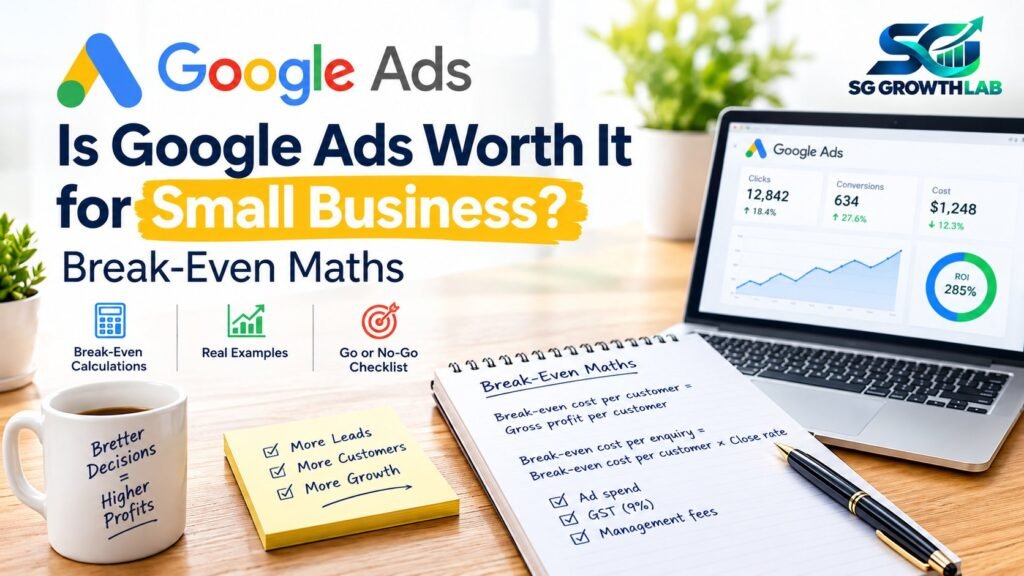
Ask ten small business owners whether Google Ads is worth it, and you will hear ten different stories. Some say it was the best money they ever spent. Others say it burned thousands with nothing to show. Both can be true, because Google Ads is not magic. It is a way of buying visitors, and whether it is worth it depends on simple maths that most people never do. Underneath those stories is the question every owner really asks: is Google Ads worth it for small business?
This guide shows you how to do that maths in a few minutes, using your own numbers, before you spend serious money. You will learn how to calculate your break-even point, see two worked examples, learn when Google Ads is not worth it and get a simple scorecard for a go or no-go decision.
On this page:
- The Short Answer
- Step 1: Know What a Customer Is Worth
- Step 2: Find Your Break-Even Cost per Customer
- Step 3: Turn It Into a Break-Even Cost per Enquiry
- Step 4: Check the Clicks
- Worked Example 1: A Service Business
- Worked Example 2: An Online Store
- What About GST and Management Fees?
- When Google Ads Is Probably Worth It
- When Google Ads Is Probably Not Worth It Yet
- How to Run a Proper Test
- A Simple Go or No-Go Scorecard
- Common Reasons Google Ads Fails
- How SG Growth Lab Helps
- Frequently Asked Questions
- Final Thoughts
The Short Answer
So, is Google Ads worth it for small business? Google Ads is worth it when the profit from the customers it brings is higher than what you pay for ads, GST and management, and when your business can turn clicks into enquiries and enquiries into customers. It is usually not worth it when your profit per customer is very small, your website cannot convert visitors, you cannot answer enquiries quickly or you are not tracking results. The only way to know for your own business is to work out your break-even numbers and run a controlled test.
Step 1: Know What a Customer Is Worth
Everything starts here. Work out the profit per customer, not the revenue.
- Revenue per customer: the average amount a new customer pays you.
- Minus your direct costs: materials, staff time, delivery, fees and anything else it costs to serve them.
- Equals gross profit per customer.
If customers come back, include lifetime value: the total profit you expect from one customer over time. A cleaning company with monthly customers earns far more per customer than a one-off job suggests. But be cautious and use realistic repeat numbers, not hopes.
Step 2: Find Your Break-Even Cost per Customer
Your break-even cost per customer is the most you can pay in advertising to win one customer without losing money. Formula: break-even cost per customer = gross profit per customer.
If a new customer brings S$400 of profit, you must win them for less than S$400 in total costs, or you lose money on that customer. To make a real profit, aim well below break-even.
Include everything in your cost: ad spend, GST if it applies, and management fees. Singapore’s GST rate is 9%, and Google Ads accounts with a Singapore business address are generally billed GST on advertising, so check your billing and ask your accountant whether you can claim it back.
Step 3: Turn It Into a Break-Even Cost per Enquiry
Because ads bring enquiries first and customers second, you also need to know how much you can pay for each enquiry. Formula: break-even cost per enquiry = break-even cost per customer multiplied by your close rate.
If you can pay S$400 per customer and you close 1 in 4 enquiries (25%), then your break-even cost per enquiry is S$100. If your campaigns bring enquiries for less than that, you are on the right side of the line. If they cost more, you are losing money on each one.
Step 4: Check the Clicks
An enquiry costs what clicks cost divided by how many clicks it takes to get one. Formula: cost per enquiry = cost per click divided by your website conversion rate.
If clicks cost S$5 and 5% of visitors enquire, then each enquiry costs S$100. In this example, you would just break even. To make a profit, you need to improve one of the three levers: a lower click price, a higher conversion rate or a higher close rate.
Worked Example 1: A Service Business
These numbers are hypothetical and for illustration only. An aircon servicing company wants to know if Google Ads is worth testing.
- Average first-job revenue: S$250. Direct costs: S$130. Gross profit: S$120.
- About 30% of customers book again within a year, adding a bit more profit, so the owner uses a cautious lifetime profit of S$150 per customer.
- Break-even cost per customer: S$150.
- Close rate: 1 in 3 enquiries, so break-even cost per enquiry is about S$50.
- Estimated click price: S$5. Landing page conversion rate: 8%.
- Cost per enquiry: S$5 divided by 0.08 is about S$62.50.
Result: at these numbers, each enquiry costs more than the S$50 break-even, so the business would lose money. But the maths also shows what to fix. If a stronger landing page lifts conversion to 12%, cost per enquiry drops to about S$42, which is below break-even. If replies become faster and the close rate rises to 40%, break-even cost per enquiry rises to about S$60. The owner now knows exactly what to test.
Worked Example 2: An Online Store
Hypothetical numbers again. A store sells a product for S$80 with a gross margin of 40%, so gross profit per sale is S$32 before ad costs.
- Break-even ROAS (return on ad spend) is 1 divided by the profit margin. At 40%, that is 2.5.
- That means every S$1 of ads must bring at least S$2.50 in sales just to break even.
- To make a profit, the store needs a ROAS comfortably above 2.5. With repeat customers, the true break-even may be lower.
If your ads are bringing S$2 in sales for each S$1 spent, you are losing money on first purchases unless repeat sales make up the difference. Also include GST and any management fee in the cost side. See our guides on Google Shopping Ads and ecommerce website design.
What About GST and Management Fees?
Add them to the cost side of every calculation:
- GST: if 9% GST is added to your ad spend, S$1,000 of ads actually costs about S$1,090.
- Management fee: if you hire help, add the fee to your total cost before you work out cost per customer. See our guide on Google Ads freelancer vs agency vs DIY.
When Google Ads Is Probably Worth It
- Your profit per customer is high enough to cover clicks, GST and fees comfortably.
- People actively search for what you sell.
- You have a fast, clear landing page and an easy way to contact you.
- You answer enquiries quickly.
- You can track calls, forms and WhatsApp clicks.
- You are willing to test for long enough to learn, usually 60 to 90 days.
When Google Ads Is Probably Not Worth It Yet
- Very low profit per customer with no repeat business. The cost of a click may be too close to what the sale is worth.
- A weak website. Fix the page first, or you will pay for clicks that leave.
- No tracking. You will not know what is working.
- Nobody can answer leads. Enquiries that wait for hours are often lost.
- Almost no search demand. If nobody searches for your service, Search ads cannot help much, and Meta ads or other channels may suit you better. See our guide on Google Ads vs Facebook Ads in Singapore.
- Very long sales cycles with no follow-up system. Leads may take months to decide, so you need a way to stay in touch.
- A budget too small to learn from. See our budget planner.
How to Run a Proper Test
- Set your break-even numbers first using the steps above.
- Set up conversion tracking for calls, forms and WhatsApp clicks.
- Start narrow: a small set of high-intent keywords and a single landing page.
- Choose a test budget you can afford to lose and a fixed period, such as 60 to 90 days.
- Review search terms weekly and remove wasted spend.
- Record every enquiry and whether it became a customer.
- At the end, compare your real cost per customer with your break-even.
- Decide: scale, fix or stop. If you are not sure what to expect in the early weeks, read our guide on how long Google Ads take to work.
A Simple Go or No-Go Scorecard
Score each line 0 (no), 1 (partly) or 2 (yes):
- My profit per customer comfortably covers clicks, GST and fees.
- People search for my service in Singapore.
- My website or landing page loads fast and is clear on mobile.
- I can track calls, forms and WhatsApp clicks.
- I can reply to enquiries within a short time during ad hours.
- I can afford to test for 60 to 90 days.
- I know my close rate, or I can measure it.
- I have realistic expectations and no guaranteed-result promises.
Out of 16: a high score suggests you are ready to test. A middle score suggests fixing a few things first. A low score suggests fixing the basics before you spend on ads.
Common Reasons Google Ads Fails
- No break-even maths before spending.
- Broken or missing conversion tracking.
- Broad keywords with no negative keywords.
- A landing page that does not answer the visitor’s question.
- Slow or missed follow-up on enquiries.
- Giving up after two weeks, or changing everything every few days.
- Judging by clicks instead of customers. Read our full audit checklist in Google Ads mistakes in Singapore.
How SG Growth Lab Helps
We start with a free audit and work through your break-even numbers with you before you spend anything. If the maths does not work yet, we will tell you what to fix first, even if that means not running ads right now. You get a clear plan with price and timeline, honest reporting, your accounts in your name and no long-term contracts.
Try our free PPC ROI calculator, learn more about our Google Ads service, or message us on WhatsApp for a free audit.
Frequently Asked Questions
Is Google Ads worth it for a small business in Singapore?
It can be, if your profit per customer covers your cost per customer including GST and fees, and your website and follow-up convert well. The only reliable way to know is to calculate your break-even numbers and run a controlled test.
How do I calculate whether Google Ads is profitable?
Work out your gross profit per customer, which is your break-even cost per customer. Multiply by your close rate to get your break-even cost per enquiry, and compare it with the real cost per enquiry from your campaigns, including GST and fees.
What is break-even ROAS?
It is the return on ad spend at which you neither make nor lose money. Calculate it as 1 divided by your profit margin. At a 40% margin, break-even ROAS is 2.5, so each S$1 of ads must bring S$2.50 in sales.
How long should I test Google Ads before deciding?
Many businesses need 60 to 90 days to collect enough data, and longer if the sales cycle is long. Avoid judging the results in the first couple of weeks.
What if my numbers do not work?
Change one thing at a time: improve the landing page, target more specific keywords, lower wasted spend, speed up replies or raise the value of each customer. If none of that makes the maths work, a different channel may suit you better.
Does GST affect whether Google Ads is worth it?
Yes. If 9% GST is added to your ad spend and you cannot claim it back, it is a real cost and raises your cost per customer. Ask your accountant how GST applies to your business.
Final Thoughts
Is Google Ads worth it for small business? It is worth it when the maths works and the business is ready to turn clicks into customers. Work out your profit per customer, calculate your break-even cost per customer and per enquiry, test with a budget you can afford and judge the results by customers, not clicks. If the numbers do not work yet, you have learned what to fix before you waste money.
Want help doing the maths for your business? Get a free audit from SG Growth Lab and we will go through it together.