
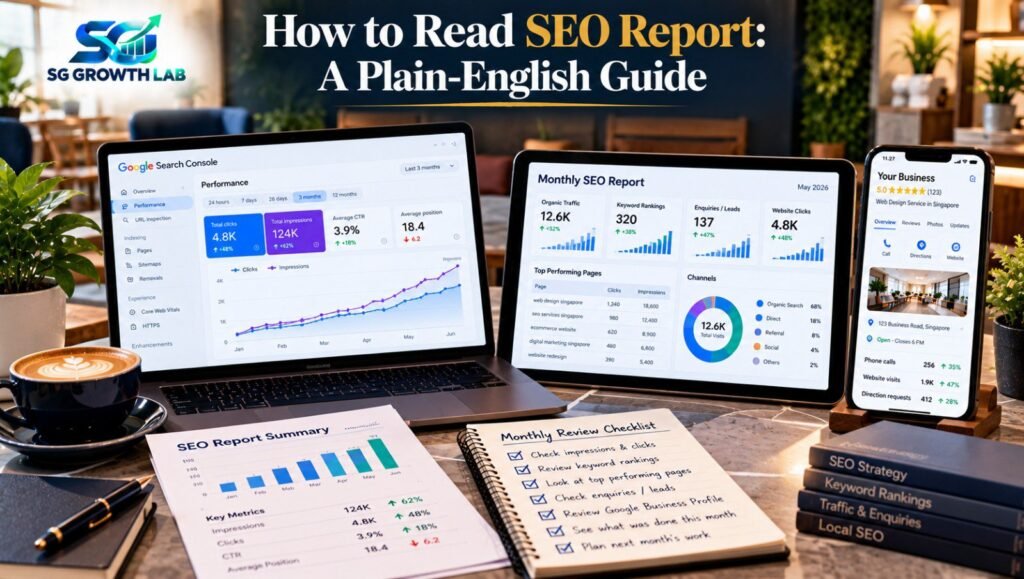
Every month, many business owners receive an SEO report full of charts, percentages and terms they do not recognise. It looks impressive, but they are left with one question: is this actually working? If you do not know how to read an SEO report, you cannot tell good work from busy work, and you cannot judge whether you are getting value.
This guide explains the numbers in plain English, shows which ones matter to your business, and gives you a simple routine for reviewing your results every month. You do not need to be technical.
On this page:
- What a Good SEO Report Should Do
- The Numbers That Matter Most
- Numbers That Look Impressive but Mean Little
- How to Spot a Weak or Misleading Report
- Why Numbers Go Up and Down
- A 10-Minute Monthly Review Routine
- Questions to Ask Your SEO Provider About the Report
- What You Should Always Have Access To
- A Simple Sample Report Outline
- How SG Growth Lab Reports
- Frequently Asked Questions
- Final Thoughts
What a Good SEO Report Should Do
A good report answers three questions in simple words:
- What was done this month? The work completed, such as pages improved, content published and technical fixes.
- What changed? Movement in visibility, traffic and enquiries.
- What happens next? The plan for the coming month and why.
If a report is only a stack of charts with no explanation of the work or the next steps, it is not doing its job.
The Numbers That Matter Most
Impressions
What it means: how many times your pages appeared in Google search results. This comes from Google Search Console. Why it matters: it is often the first number to grow when SEO starts working, because your pages are being shown before they are clicked. How to read it: look for a steady upward trend over several months. Small ups and downs are normal.
Clicks
What it means: how many times people clicked your pages from Google search results. Why it matters: clicks are real visits from search. Growing clicks show that you are being found and chosen. How to read it: compare to the same period last month and last year if you have it, because some businesses have busy and quiet seasons.
Click-through rate (CTR)
What it means: the percentage of impressions that became clicks. Why it matters: a low click-through rate on a page that appears often suggests that the title or description is not convincing. How to read it: do not compare a branded search, where people already know you, with a general search. They behave very differently.
Average position
What it means: the average ranking of your pages for the searches where they appeared. Position 1 is the top of the results. Why it matters: it shows direction. Moving from position 40 to position 15 is real progress, even if clicks have not jumped yet. How to read it: treat it as a rough guide, not an exact score. Average position can look worse when you start appearing for more searches, because new, lower-ranking searches pull the average down.
Keyword rankings
What it means: where your site appears for specific searches that you and your provider have chosen. Why it matters: it shows whether the right searches are improving. How to read it: check that the keywords are relevant to your customers and not only easy ones or your own business name. Rankings can differ by device and location, so expect small differences between tools.
Organic traffic
What it means: visits to your website that came from unpaid search results, usually shown in Google Analytics. Why it matters: it shows how many people from search actually reached your site. How to read it: look at which pages receive the traffic. Traffic to your service pages is more useful than traffic to an unrelated blog post.
Conversions and enquiries
What it means: the actions that matter to you, such as phone calls, contact forms, WhatsApp clicks, bookings or purchases. Why it matters: this is the number that connects SEO to your income. A report without it is incomplete. How to read it: ask for these to be tracked properly. If you do not know how many enquiries came from Google, ask your provider to set it up and also ask new customers how they found you.
Google Business Profile activity
What it means: how many people viewed your profile, called you, requested directions or visited your website from it. Why it matters: for local businesses, this often brings more enquiries than the website. See our guide on Google Business Profile SEO in Singapore. How to read it: watch calls and direction requests, not only views.
Backlinks
What it means: links from other websites to yours. Why it matters: quality links help build trust and authority over time. How to read it: quality matters more than quantity. A few relevant local links beat many unrelated ones. Ask where new links came from.
Technical health
What it means: whether Google can find and understand your pages, and whether your site is fast and works on mobile. Search Console shows indexing and mobile issues. Why it matters: technical problems can quietly hold back everything else. How to read it: look for the number of indexed pages, errors and any warnings, and ask what is being fixed.
Numbers That Look Impressive but Mean Little
- Total keywords tracked or ranking, with no detail on which ones matter.
- Rankings for your own business name, which you would usually appear for anyway.
- Domain scores from third-party tools, which are estimates and not used by Google.
- Traffic from irrelevant countries or topics.
- Vague “SEO scores” with no clear explanation.
These are not useless, but they should never replace impressions, clicks and enquiries.
How to Spot a Weak or Misleading Report
- No explanation of the work actually done.
- Only rankings, with no traffic or enquiries.
- Rankings that focus on your brand name or very easy phrases.
- Automatic reports that look identical for every client.
- Numbers shown without comparison to earlier months.
- Good news only, with no mention of problems or what will change.
- No plan for the next month.
- No access to your own accounts to check the numbers.
If you want to compare providers, our guide on questions to ask an SEO agency helps you ask for the right reporting.
Why Numbers Go Up and Down
Do not panic over a single weak month. Common reasons include:
- Seasonality
- Google updates
- Competitors
- Public holidays and events
- Tracking changes
Look at the trend over three to six months, not one month. Our guide on how long SEO takes in Singapore explains what to expect at each stage.
A 10-Minute Monthly Review Routine
- Read the summary first. What was done and what changed?
- Check impressions and clicks against last month and the same month last year.
- Look at enquiries. Calls, forms and WhatsApp messages from Google.
- Check your Google Business Profile. Calls, directions and reviews.
- Review the top pages. Are service pages growing?
- Read the plan for next month and ask about anything unclear.
Questions to Ask Your SEO Provider About the Report
- What work did you complete this month, and why those tasks?
- Which numbers improved, and which did not?
- How many enquiries came from search, and how do you know?
- Which pages and keywords are closest to page one?
- Is anything holding us back, such as technical problems?
- What will you focus on next month?
What You Should Always Have Access To
You should be able to log in to your own Google Search Console, Google Analytics and Google Business Profile and see the same numbers. If your provider will not give you access, you cannot verify the report.
Read our guide on SEO contracts in Singapore for what to agree before you sign.
A Simple Sample Report Outline
A clear monthly report for a small business can be as short as one or two pages:
- Summary (three or four sentences in plain language)
- Work completed (a short list)
- Results (impressions, clicks, enquiries and Google Business Profile activity compared with last month)
- Top pages and keywords (what is working)
- Issues and fixes (anything important found)
- Next month’s plan
How SG Growth Lab Reports
We keep reports simple and honest. You receive a plain-language summary, the work completed, results that include enquiries and not only rankings, and a clear plan for the next month. You keep access to your own accounts, and we tell you when something has not worked. There are no fake ranking promises and no long-term contracts. Learn more about our SEO services, or message us on WhatsApp for a free audit.
Frequently Asked Questions
What is the most important number in an SEO report?
For most businesses, it is enquiries from search, such as calls, forms and WhatsApp messages. Impressions, clicks and rankings are useful because they show progress towards enquiries, but enquiries show the actual business result.
What is a good average position?
There is no single number. Position 1 to 3 is the best, and page one covers roughly the top ten results. For a growing site, the direction matters more than the exact figure. Moving from deep pages towards page one is good progress.
Why are my impressions up but clicks flat?
Your pages are appearing more often, but not yet high enough or with titles convincing enough to earn clicks. This is common in the early months. Improving titles, descriptions and rankings usually helps.
Why did my traffic drop this month?
It can be seasonal, a Google update, a competitor change or a tracking issue. Check the trend over several months and ask your provider to explain the cause before reacting.
Which tools should I use to check my own numbers?
Google Search Console shows how your site appears in search, Google Analytics shows what visitors do on your website, and your Google Business Profile shows local activity. All three are free and should be in your name.
How often should I receive an SEO report?
Monthly is standard for most small businesses. Early on, a short check-in call helps you understand what you are seeing.
Final Thoughts
You do not need to be an expert to understand how to read an SEO report. Focus on a few things: what work was done, whether impressions and clicks are trending up, whether enquiries are growing and what the plan is next. Be careful of reports that hide behind jargon or only show rankings, and make sure you can check the numbers in your own accounts. Want reports you can actually understand? Get a free audit from SG Growth Lab and see how we explain results in plain words.