
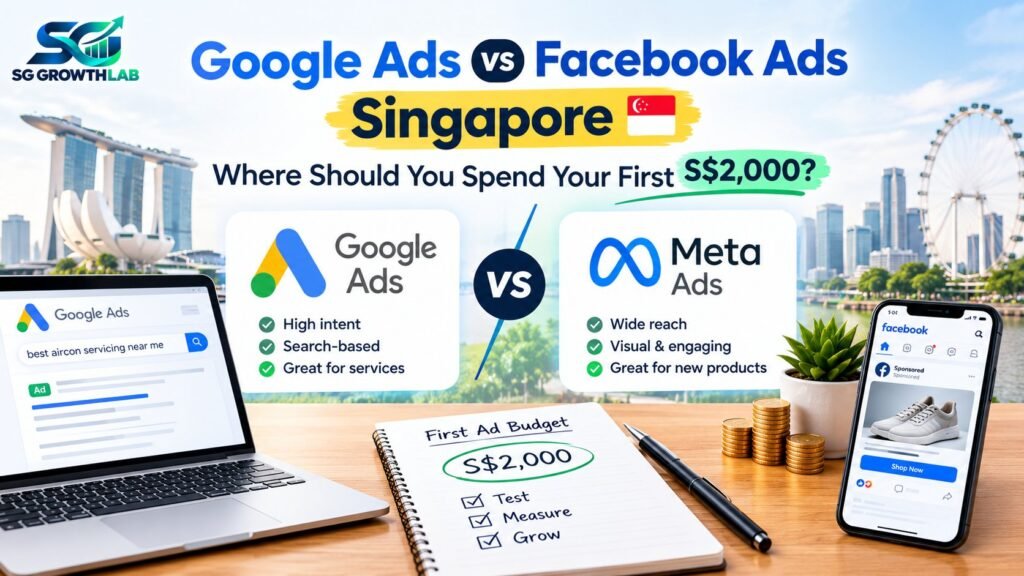
You have a small budget and a business to grow. Everyone has an opinion: one friend swears by Google Ads, another says Facebook and Instagram brought all their customers. Both can be right, because they are very different tools that suit different situations.
This guide explains how Google Ads and Facebook ads (Meta ads) differ, which one fits which kind of business and gives you three simple 30-day test plans for a first budget of S$2,000. The figure is a hypothetical example. Use the same thinking with whatever budget you have.
On this page
- The Short Answer
- How They Differ
- Side by Side
- Which One Fits Your Business?
- Your S$2,000 Budget: What It Really Buys
- Three Simple 30-Day Test Plans
- How to Decide After 30 Days
- Your Website Matters More Than the Channel
- Common Mistakes With a First Ad Budget
- Where SEO Fits In
- How SG Growth Lab Helps You Choose
- Final Thoughts
- Frequently Asked Questions
The Short Answer
If your customers actively search for what you sell, such as “aircon servicing” or “tuition centre near me”, Google Search ads usually give you the most direct route to enquiries. If your product is new, visual or something people would not search for by name, Facebook and Instagram ads can create interest and reach people who are not looking yet. With a small first budget, it is usually better to test one channel properly than to split money across both.
How They Differ
Google Ads (Search)
People type what they want, and your ad appears at that moment. Intent is high, because the person is already looking. You choose keywords, write the ads and send visitors to a landing page. Cost per click can be higher in competitive industries, but the visitors are often closer to buying. Learn more about our Google Ads service.
Facebook and Instagram ads (Meta ads)
Your ad interrupts people while they scroll. You choose who sees it by location, interests and behaviour. The ad has to catch attention with a strong image or video and a clear offer. Reach can be wide and clicks can be cheaper, but many people are not ready to buy when they see the ad. Learn more about our Meta ads service.
Side by Side
- Customer intent: Google Search reaches people actively searching. Meta reaches people who may not be looking yet.
- What you need to start: Google needs keywords, ad text and a good landing page. Meta also needs strong creative, such as images or short videos.
- Speed to first enquiries: both can start within days, but Google often produces ready-to-buy enquiries sooner for services people search for.
- Cost per click: often higher on Google for competitive industries, often lower on Meta, but the cost per customer is what matters.
- Lead quality: Google leads are often more intent-driven. Meta leads can be strong when the offer is attractive, but may need more follow-up.
- Best at: Google captures existing demand. Meta creates demand and brings people back.
- Targeting: Google targets by search phrase. Meta targets by audience.
- Creative effort: Google is mainly words. Meta needs fresh visuals more often.
Which One Fits Your Business?
Choose Google Ads first if
- People search for your service with clear intent, such as repairs, cleaning, moving, legal help, clinics, tuition or installation.
- You need enquiries quickly.
- You have a clear service page or landing page.
- Your customers have urgent needs.
Choose Meta ads first if
- Your product or offer is new, visual or lifestyle-based, such as fashion, food, events or beauty.
- People would not search for it by name yet.
- You have strong photos or short videos.
- You want to build awareness or an email and WhatsApp audience.
Consider both, in order, if
- You sell products online. Google Shopping and search capture buyers, while Meta supports discovery and retargeting. See our guide on Google Shopping Ads.
- You already have steady website visitors. Retargeting them on Meta or Google can bring them back. See Google remarketing.
Your S$2,000 Budget: What It Really Buys
A hypothetical S$2,000 budget is smaller than it looks once you account for GST. Singapore’s GST rate is 9%, and ad accounts with a Singapore business address are generally billed GST on advertising, so check your billing details. If the S$2,000 includes GST, you have roughly S$1,835 of actual media to spend, because 2,000 divided by 1.09 is about 1,835. If you pay an agency or freelancer, their fee also comes from your total, so plan the numbers before you start.
Over a 30-day test, S$1,835 of ad spend is about S$60 a day. At a click price of S$4, for example, that buys about 450 clicks in a month. That is enough to learn something, but not enough to run many experiments at once. This is why a focused test works better than a spread-out one.
These numbers are illustrations, not promises. Use Google’s free Keyword Planner to see click price estimates for your own keywords.
Three Simple 30-Day Test Plans
Plan A: Google Search only
Best for: services people search for.
- Put the whole test budget into one Search campaign with a small group of high-intent keywords, such as your main service plus Singapore or your area.
- Send visitors to one landing page with a clear offer and an easy WhatsApp or call button. See our landing page service.
- Set up conversion tracking for calls, forms and WhatsApp clicks before you spend.
- Review search terms every few days and add negative keywords.
- Judge the result by enquiries and cost per enquiry.
Plan B: Meta ads only
Best for: visual, new or lifestyle offers.
- Put the whole test budget into one campaign with one clear offer, such as a promotion, free consultation or trial.
- Test two or three different images or videos and two different headlines, not twenty.
- Target a realistic local audience first, not all of Singapore, unless you serve the whole country.
- Use a simple lead form or a WhatsApp message button.
- Judge the result by enquiries, and by how many enquiries turn into customers.
Plan C: A split test, with a clear rule
Best for: businesses that are unsure which channel fits and can afford to learn.
- Put most of the budget into the channel you believe fits best, and a smaller share into the other.
- Use the same offer and landing page so the comparison is fair.
- Track cost per enquiry and cost per customer for each channel separately.
- At the end of 30 days, move the budget towards the one that gave better results.
The smaller the budget, the more important it is to keep the test simple. If a split would leave either channel with too few clicks to learn from, choose Plan A or Plan B instead.
How to Decide After 30 Days
Use clear rules before you start, so you do not decide on feelings:
- Cost per enquiry: is it low enough compared with your profit per customer?
- Enquiry quality: did the enquiries match the customers you want?
- Close rate: how many enquiries became customers?
- Volume: can the channel scale if you spend more?
- Effort: do you have the time and creative resources to keep it running?
If a channel brought profitable customers, keep it and increase the budget gradually. If it did not, look at the cause before you judge the channel: weak tracking, a weak page, the wrong audience or slow follow-up are common culprits.
Your Website Matters More Than the Channel
Both channels send visitors to your website. A slow site, confusing message or hard-to-use contact options will waste money on either one. Before you spend, check that your page loads fast on mobile, your offer is clear in a few seconds and your phone or WhatsApp is easy to reach.
Common Mistakes With a First Ad Budget
- Splitting a small budget across too many campaigns or channels.
- Running ads without conversion tracking.
- Sending all traffic to the homepage.
- Judging by clicks, likes or reach instead of enquiries.
- Changing everything every few days.
- Not replying to enquiries quickly.
- Ignoring GST and fees when planning the budget.
Where SEO Fits In
Paid ads stop when your budget stops. SEO and your Google Business Profile build visibility that can keep working. Many small businesses start with one paid channel for speed and build SEO alongside it.
How SG Growth Lab Helps You Choose
We start with a free audit and an honest recommendation, even if the answer is to start with one channel and a smaller budget. You receive a clear plan with price and timeline, your ad budget goes directly to the platform and your accounts stay in your name. Reporting is honest and focused on enquiries, with no long-term contracts and no fake promises.
Learn more about our Google Ads and Meta ads services, or message us on WhatsApp for a free audit.
Final Thoughts
Google Ads vs Facebook Ads Singapore businesses compare is really a question about your customers: are they searching for you now, or do you need to introduce yourself first? Pick one channel that fits, give it a focused 30-day test, track enquiries and customers, and let the numbers tell you what to do with the next dollar.
Want honest advice on where to start? Get a free audit from SG Growth Lab and we will recommend a simple first test.
Frequently Asked Questions
Is Google Ads or Facebook Ads better for a small business in Singapore?
Neither is better in every case. Google Search is usually stronger when customers actively search for your service, while Meta ads are usually stronger for visual, new or lifestyle offers. Test one channel properly first.
Should I run both Google Ads and Facebook Ads at the same time?
Only if your budget is large enough to give each enough clicks to learn from. With a small budget, one focused channel at a time is usually more effective.
Which is cheaper, Google Ads or Facebook Ads?
Clicks are often cheaper on Meta, but cost per click is not the same as cost per customer. Compare cost per enquiry and cost per customer, which depend on your offer, landing page and follow-up.
How long should I test before deciding?
Thirty days gives you a first look, but some businesses need longer, especially with longer sales cycles. Decide your success rules before you start, and avoid changing too much during the test.
Do I need a website for Facebook Ads?
Not always, since you can use lead forms or WhatsApp messages, but a clear landing page usually improves results and gives you more tracking options.
Does GST apply to Facebook and Google ads in Singapore?
Advertising accounts with a Singapore business address are generally billed GST, which is 9%. Check your billing details on each platform and ask your accountant how it applies to you.