
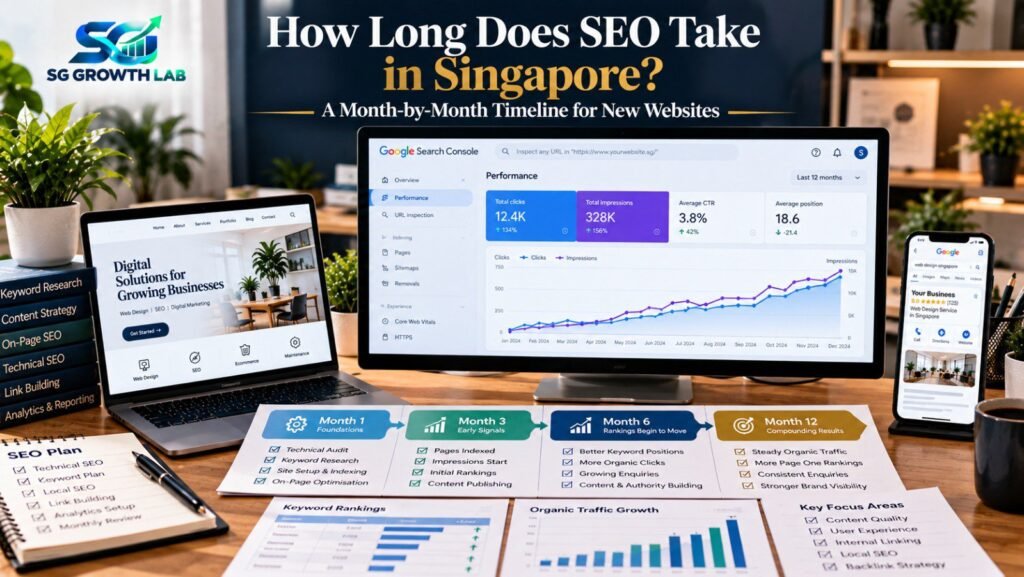
If you have searched “how long does SEO take Singapore”, you have probably seen answers ranging from “a few weeks” to “more than a year”. Both can be true, depending on your website, your industry and your competition. The honest answer is less exciting than a quick promise, but it will help you plan your budget and avoid being disappointed. This guide gives you a realistic, month-by-month timeline for a new website, explains what speeds results up or slows them down, and shows the early signs that SEO is working before your traffic jumps.
The Short Answer
SEO usually takes several months to show meaningful results. For a new website, early movement such as indexing and impressions often appears in the first one to three months, rankings usually start improving between months three and six, and steady traffic and enquiries commonly build between six and twelve months. Local businesses with low competition can see results sooner, while competitive industries can take longer. These are general guides, not guarantees, because nobody controls Google’s rankings.
Month-by-Month SEO Timeline for a New Website
Month 1: Foundations
The first month is about getting the basics right, so everything that follows can work.
- SEO audit and technical checks, such as speed, mobile design and indexing.
- Keyword research to choose the searches worth targeting.
- Fixing structure issues, titles, headings and internal links.
- Setting up Google Search Console, Analytics and your Google Business Profile.
What you will usually see: very little traffic change. This is normal. The work is mostly behind the scenes.
Month 2: On-page optimisation and content
- Optimising your key service pages for their target keywords.
- Creating new content that answers customer questions.
- Improving local signals, such as consistent business details and reviews.
What you will usually see: Google starts to discover and index your pages, and impressions may begin to appear in Search Console.
Month 3: Early signals
- Continuing content and page improvements.
- Starting quality link building or local citations.
- Checking which pages Google is showing and for which searches.
What you will usually see: more impressions, and some pages beginning to appear in lower positions, often beyond page one. Clicks are still small.
Months 4 to 6: Rankings begin to move
- Strengthening the pages that are close to page one.
- Publishing more helpful content and building authority.
- Improving click-through with better titles and descriptions.
What you will usually see: keywords climbing from deeper pages towards page two and page one, the first steady clicks, and sometimes the first enquiries from organic search. Less competitive and local searches usually move first.
Months 6 to 9: Traffic and enquiries grow
- Expanding content around your best-performing topics.
- Earning more quality links and reviews.
- Improving pages so visitors turn into enquiries.
What you will usually see: noticeably steadier traffic, more keywords on page one, and a clearer link between SEO and calls, forms or WhatsApp messages.
Months 9 to 12 and beyond: Compounding results
- Scaling what works and fixing what does not.
- Targeting more competitive keywords as your site gains trust.
- Maintaining content and technical health.
What you will usually see: SEO becoming one of your more reliable sources of enquiries, with results that build on each other over time.
Quick Wins vs Slow Wins
Not everything in SEO takes the same amount of time.
Often faster (weeks to a few months):
- Fixing technical problems that block Google, such as pages set to “noindex” by mistake.
- Optimising and improving your Google Business Profile for local searches.
- Improving titles and descriptions on pages that already get impressions.
- Adding useful content for low-competition, specific searches.
Usually slower (several months or more):
- Ranking a new website for highly competitive keywords.
- Building real authority through quality links and mentions.
- Growing a broad base of content that ranks across many topics.
What Affects How Long SEO Takes?
- Competition: ranking for a crowded search takes more time than a specific, local one.
- Website age and authority: a brand-new site starts with little trust, while an established site can move faster.
- Website condition: slow speed, poor mobile design or technical errors hold results back.
- Content quality and quantity: helpful, relevant content takes time to produce and be recognised.
- Links and mentions: quality references from other websites build trust, but they take time to earn.
- Local or national targeting: local searches are often easier than national ones.
- Consistency: steady work beats short bursts of effort.
- Google updates: algorithm changes can speed up or slow down progress.
Local Keywords vs Competitive Keywords
A local search such as a service plus a neighbourhood usually has fewer competitors and clearer intent, so it often responds sooner. A broad, high-volume search that many large companies target takes much longer, and may need a strong website and many months of work. A sensible plan starts with specific, local searches to win early enquiries, and then moves towards broader terms as your site grows. Our Google Map reputation service can support local visibility while your website builds strength.
Early Signs That SEO Is Working
Traffic is not the first thing to move. Look for these earlier signals:
- Your pages are indexed in Google Search Console.
- Impressions are rising, even if clicks are still low.
- Keywords are moving from very deep pages (such as positions 50 and below) towards the top 20.
- Your Google Business Profile views, calls and direction requests are growing.
- More people search for your business name directly.
- You start receiving calls, forms or WhatsApp messages that mention finding you on Google.
What Slows SEO Down
- Pages blocked from Google by a setting or a mistake.
- A slow or poorly working mobile site.
- Thin or copied content that does not help visitors.
- Changing strategy or agency every few months, which resets progress.
- Cheap link shortcuts, which can lead to penalties.
- Expecting results too early and stopping.
- Ignoring the Google Business Profile for a local business.
How to Speed Up Results Safely
You cannot force Google, but you can remove delays.
- Start with a clean website. Fix technical issues and mobile problems first.
- Target specific searches your customers actually use.
- Strengthen your Google Business Profile and collect genuine reviews.
- Publish helpful content consistently, not only once.
- Improve what is already close to page one before creating everything new.
- Track progress monthly so you can adjust early.
If you are new to SEO, our SEO guide for Singapore small businesses explains the basics in plain language.
Why “Page One in 30 Days” Is a Red Flag
Nobody can honestly promise a specific ranking in a specific number of days. Google decides rankings, and its results depend on hundreds of factors. Promises of instant page one results often rely on very low-competition keywords that bring no customers, or on risky shortcuts that can harm your site later. A trustworthy company explains the timeline, the work involved and what you can realistically expect. If you are comparing quotes, read our guide on SEO pricing in Singapore.
If You Need Results Faster
SEO builds over time, so if you need enquiries sooner, paid ads can work alongside it. Google Ads can bring visitors quickly while your SEO grows, and the two can support each other. The difference is that ads stop when the budget stops, while SEO results can keep building.
How SG Growth Lab Sets Expectations
We start with a free audit and tell you honestly what is likely, what will take longer and what we do not control. You receive a clear plan with timeline, honest reporting, and no fake ranking promises or long-term contracts. You work with a real SEO specialist, and we explain progress in plain words, including the early signs that matter. Learn more about our SEO services, or message us on WhatsApp for a free audit.
Frequently Asked Questions
How long does it take for SEO to work?
For most new websites, early signals appear within one to three months, rankings begin to improve between three and six months, and steadier traffic and enquiries often build between six and twelve months. The exact timing depends on your competition, website and the work done.
Can SEO work in one month?
Some quick improvements can appear in a month, such as better indexing or a stronger Google Business Profile, but significant rankings and traffic from a new website rarely appear that fast. Be careful of anyone who promises big results in one month.
Why is my new website not ranking yet?
New websites start with little trust in Google’s eyes. Pages need to be found, indexed and tested over time, and competitive searches take longer. Check that your pages are indexed, your site is fast and mobile-friendly, and your content matches what people search for.
Is SEO faster for local businesses?
Often, yes. Local searches usually have less competition and clearer intent, so local businesses can sometimes see movement sooner, especially with a well-optimised Google Business Profile and genuine reviews.
What should I track in the first few months?
Track indexing, impressions and keyword positions in Google Search Console, Google Business Profile views and calls, and the number of enquiries that come from Google. These show progress before traffic grows.
Do I need to keep doing SEO after I rank?
Yes, in most cases. Competitors keep improving, and Google keeps changing. Ongoing content, technical care and reviews help you keep and grow your rankings.
Final Thoughts
So, how long does SEO take in Singapore? Usually several months, with early signals in the first few months and steadier results over six to twelve months. Local, specific searches move sooner, competitive ones take longer, and nobody can promise exact dates. Choose a team that sets honest expectations, track the early signs and stay consistent, and SEO can become one of your most valuable sources of customers. Want an honest SEO plan and timeline for your website? Get a free audit from SG Growth Lab and we will tell you what to expect.